Commercial lighting does more than make a workplace look bright. It helps people notice steps, read signs, recognize hazards, and move through shared spaces with greater confidence. In a loading area, for example, even light across the floor can make a pallet jack or spilled liquid easier to see. At an office entrance, clear illumination can help visitors find the reception desk without guessing. These details matter. They can reduce avoidable mistakes, although lighting cannot prevent every accident.
Understanding how to improve safety with commercial lighting systems starts with the space and the people using it. A careful assessment considers task requirements, shadowed corners, glare on screens, changing daylight, and the condition of existing fixtures. Light levels should suit the work rather than simply be as high as possible. Too much brightness can cause discomfort or obscure visual details. A bright room can still feel wrong.
Useful improvements may include more uniform light, suitable color rendering, controls for different operating hours, and prompt replacement of failing lamps. In warehouses, aisles and intersections deserve particular attention. In stairwells and corridors, consistent illumination helps people judge edges and changes in floor level. Regular inspections also matter, since dust, damaged lenses, or aging equipment can gradually reduce performance. The right solution depends on the building, its activities, and user feedback. Measure where possible, observe how people actually move, and revisit assumptions when problems remain. Good lighting is practical, but it is not a substitute for clear walkways, training, or other safety measures.
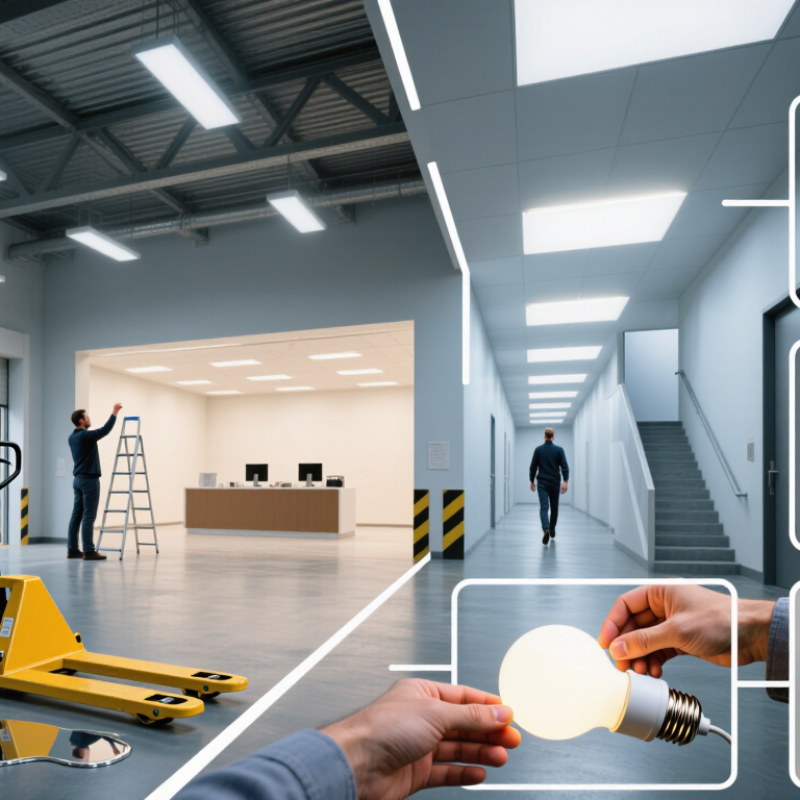
In a warehouse aisle, a weak ceiling lamp can hide a loose strap, a wet patch, or a raised floor edge. Good commercial lighting makes these hazards easier to spot before someone steps on them. The U.S. Bureau of Labor Statistics reported 450,540 workplace cases involving falls, slips, and trips in 2022. Lighting cannot prevent every incident, but clear visibility helps workers notice obstacles and changes in floor level sooner.
Look beyond the floor. Even, well-positioned light can reveal leaking pipes, damaged cables, blocked exit signs, and clutter near fire equipment. In manufacturing areas, it can help workers see sharp edges, moving parts, and warning labels. The Illuminating Engineering Society’s recommended practice for industrial facilities, ANSI/IES RP-7, provides task-based guidance on lighting levels and visual conditions. The right level depends on the work. A bright fixture in the wrong place can cast hard shadows or glare across a screen.
Walk the space at the start of a shift. Check corners, stair treads, loading docks, and the area beneath shelving. Replace failed lamps promptly, and investigate dark patches rather than assuming workers will adapt. One limitation: brighter light alone is not a safety plan. Dust, poor contrast, and reflective floors can still conceal hazards. I have seen overlooked shadows persist after a lighting upgrade; the layout needed attention too.
| Workplace Hazard | Where It Commonly Occurs | What Adequate Lighting Helps Reveal | Useful Lighting Measure | Potential Safety Benefit |
|---|---|---|---|---|
| Slips and trip hazards | Walkways, loading areas, entrances, and around equipment | Spills, loose materials, changes in floor level, and objects left in walking paths | Even illumination across the walking surface; prompt replacement of failed lamps | Workers can notice obstacles and unsafe floor conditions before walking into them. |
| Stairs and changes in floor level | Stairwells, ramps, platforms, and mezzanines | Step edges, handrails, ramp boundaries, and changes in elevation | Consistent light on each step, with shadows and glare controlled | Clearer visual cues can help people judge footing and navigate transitions. |
| Moving vehicles and mobile equipment | Warehouses, loading docks, parking areas, and factory routes | Pedestrians, vehicle paths, reversing equipment, and obstructions | Lighting designed for the area and task, with attention to uniformity and glare | Improved visibility can support earlier recognition of people and equipment in shared spaces. |
| Machine and tool hazards | Production lines, workshops, inspection stations, and maintenance areas | Workpiece edges, controls, moving parts, and details relevant to the task | Task lighting positioned to illuminate the work without creating distracting reflections | Workers can see the work area and controls more clearly while carrying out tasks. |
| Low-contrast objects and labels | Storage aisles, inventory areas, control panels, and workbenches | Labels, markings, color-coded controls, and objects that blend into their background | Suitable light levels and color rendering for the visual task | More legible markings can help reduce mistakes when identifying materials or controls. |
| Glare and deep shadows | Areas near bright windows, reflective surfaces, high-bay fixtures, and task lights | Glare sources and shadowed areas that obscure floors, objects, or work details | Appropriate fixture placement, shielding, and balanced light distribution | Reducing visual discomfort and concealed areas can make hazards easier to notice. |
| Dim routes during power loss | Exit routes, stairways, and occupied areas requiring evacuation | Exit signs, route boundaries, and obstacles when normal lighting fails | Maintained emergency lighting and illuminated exit signage, as required by applicable codes | Supports orientation and movement toward exits during an emergency. |
Clear light can expose wet patches, loose straps, raised floor edges, and clutter near equipment. It helps workers notice hazards sooner, but cannot prevent every incident.
Check corners, stair treads, loading docks, and spaces beneath shelving. Look for shadows around pipes, cables, exits, and fire equipment. Small details matter.
Match illumination to the task. Office work often uses about 30–50 foot-candles, while detailed label checks may need steadier light.
Yes. Glare on glossy screens or polished floors can obscure details. A poorly placed fixture may also cast hard shadows. More light is not always better.
Measure on the work surface and at several positions nearby. Check for shadows from hands, shelves, and equipment. One reading can miss dim spots.
Recheck after installation, as lamps age, and when tasks change. Dusty lenses can reduce light. I still might miss a corner.
A common code benchmark calls for 90 minutes of operation. Initially, the route needs a 1 foot-candle average and at least 0.1 foot-candle at any point.
Check floor-level paths near stair landings, door thresholds, and turns—not only beneath fixtures. Blocked doors, smoke, or a failed battery can still make an exit unsafe.
Commercial lighting improves workplace safety by making hazards easier to detect before they cause injuries. Well-planned illumination can reveal spills, uneven floors, obstacles, machinery, and other risks, while task lighting helps workers see clearly during detailed or precision work. Setting light levels with reference to IES recommendations supports visibility suited to each activity. Reducing glare and harsh shadows is equally important: both can conceal hazards, distort depth, and make movement or equipment operation less safe.
A complete safety plan also keeps exit routes visible during normal operation and power interruptions. Adequate lighting along escape paths helps occupants identify doors, changes in floor level, and obstacles when leaving a building. For emergency egress, the specified benchmark is 90 minutes of illumination, with an average of 1 foot-candle and a minimum of 0.1 foot-candle, as described in IBC 1008.3.5. Together, these measures show how to improve safety with commercial lighting systems through clear visibility, appropriate task lighting, controlled glare, and dependable emergency illumination.

 Bluu Light