Choosing the right compliance marks can determine whether a commercial lighting product is approved, specified, and trusted. Buyers often ask, “what certifications should commercial lighting products have?” The answer depends on the product, installation location, voltage, control system, and target market.
James Benya, PE, a respected lighting engineer and educator, offers a useful principle: “Safety and performance must be designed together.” That idea matters when reviewing certification documents. In North America, products may require a recognized safety listing from UL Solutions, ETL, or another accredited testing organization. LED fixtures may also pursue DLC qualification, especially when energy rebates or efficiency specifications apply. ENERGY STAR can support efficiency claims for eligible products, while FCC compliance addresses electromagnetic emissions from electronic drivers and controls.
The label is only the beginning.
A responsible purchasing review should examine the exact model number, test scope, certification file, warranty terms, and installation instructions. A certificate for one fixture family may not cover every trim, driver, sensor, or emergency option. That detail is easy to miss. I have seen product pages use broad language that sounds reassuring but leaves important questions unanswered.
Requirements also change by country, state, municipality, and project type. Wet locations, hazardous areas, healthcare facilities, and emergency lighting can require additional evaluation. Certification does not guarantee perfect illumination, long service life, or correct installation. It confirms specific tested conditions.
This guide explains the major certifications, their practical value, and the questions commercial buyers should ask before approving a product. When documentation feels incomplete, pause. That small delay may prevent a costly replacement later.
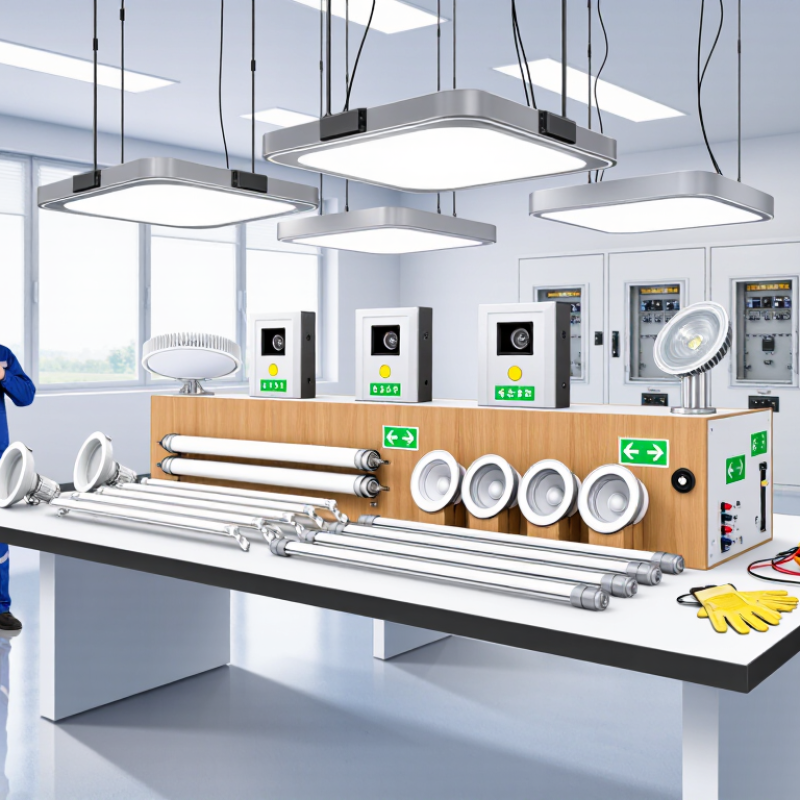
Commercial lighting equipment must prove more than brightness and efficiency. It must operate safely in offices, warehouses, schools, and public buildings. Product safety certification usually covers electric shock protection, fire resistance, insulation, grounding, and abnormal heat testing. These checks matter when a fixture runs above a crowded ceiling for twelve hours.
Certification requirements depend on the installation market and product type. A recessed luminaire may need different evaluations from a high-bay fixture or emergency light. Testing can include mechanical strength, moisture resistance, electromagnetic compatibility, and photobiological safety. Look for certification from an accredited, independent testing body. The certificate should match the exact model, electrical rating, mounting method, and listed accessories.
Details can expose weak compliance. Confirm that the marking appears on the product, not only on a sales sheet. Review the test report, factory inspection status, and certificate expiry information. Ask whether later component changes were reported and retested. A driver substitution can affect temperature and insulation results. That is easy to overlook.
Installation conditions also matter. A damp loading area, dusty workshop, or enclosed ceiling can create risks that laboratory samples do not show. Certification supports safe design, but it cannot replace qualified installation or routine inspection. In practice, documentation is sometimes incomplete. That should trigger careful verification, not an assumption of safety.
What Certifications Do Commercial Lighting Products Need?
Electrical Standards and Compliance Requirements
Commercial lighting products must meet electrical safety standards before installation. In North America, buyers often request certification from a recognized testing laboratory. Common evaluations cover grounding, insulation, fire resistance, heat, and abnormal operation. Product families may follow standards such as UL 1598 or CSA C22.2 No. 250.0. The exact requirement depends on the fixture type and installation location.
European projects usually reference IEC or EN 60598 standards. CE marking may involve safety, electromagnetic compatibility, and environmental declarations. It is not always a third-party certification. That difference deserves attention. A supplier should provide the Declaration of Conformity and relevant test reports. For products with wireless controls, electromagnetic compatibility and radio requirements may also apply. Photometric files, power data, and thermal test records support professional specification work.
Energy and environmental rules can affect purchasing decisions too. Some projects require limits for hazardous substances, energy use, or standby power. Regional efficiency programs may add testing conditions beyond basic electrical safety. Ask for certificates that match the exact model number. Similar-looking fixtures can use different drivers, housings, or components. I have seen compliance discussions fail because teams reviewed a family certificate instead of the delivered configuration. That mistake is easy to repeat. Verify the testing laboratory, report date, product scope, and marking instructions before approval. Installation still matters. Incorrect wiring, poor ventilation, or unapproved modifications can undermine compliant equipment.
Commercial lighting products need more than a safety approval. Buyers also need reliable evidence of energy performance, light quality, and long-term operation. Energy efficiency certifications help compare products under controlled testing conditions. Performance labels make the comparison visible on a specification sheet.
The International Energy Agency reported in its 2023 Energy Efficiency Market Report that lighting represents roughly 15% of global electricity consumption. Small efficiency differences therefore matter across offices, warehouses, and retail spaces. The U.S. Department of Energy’s solid-state lighting research reports show that high-performance LED systems can exceed 150 lumens per watt in suitable applications. However, that figure may describe the light source, not the complete installed fixture. Check fixture efficacy, wattage, delivered lumens, and control compatibility.
Useful labels should also show color temperature, color rendering, rated life, and lumen maintenance. A reported L70 value estimates when output may fall to 70% of its initial level. Flicker data and dimming performance deserve attention too. They are often overlooked. Independent photometric testing can verify these claims, while recognized electrical safety certification reduces installation risk. In North American projects, efficiency qualification programs and utility rebate lists may also require specific test reports.
A certification is not a guarantee of perfect performance. I have seen specifications hide poor controls behind excellent efficacy numbers. That is a practical warning. Confirm operating temperature, warranty conditions, replacement access, and actual lighting levels before approval. A well-labeled product still needs proper design.
What Certifications Do Commercial Lighting Products Need?
Regional Approvals for Commercial Lighting Markets
Commercial lighting products rarely follow one global approval path. Requirements depend on the destination, product type, voltage, controls, and installation environment. In North America, safety evaluation and electromagnetic compatibility testing are often expected before market entry. In the European Union, manufacturers commonly address CE obligations, including applicable safety and EMC requirements. The United Kingdom may require separate conformity arrangements. Australia and New Zealand use their own electrical compliance framework. Other markets can require national registration, energy documentation, or local testing.
The details matter. A recessed office panel may need different evidence from an outdoor floodlight. Emergency lighting can involve additional performance and battery requirements. Wireless controls may trigger radio equipment rules. I have seen projects delayed because a test report covered the lamp, but not the complete fixture. That mistake is expensive. Approval marks alone are not enough. Authorities, distributors, and contractors may also request declarations, technical files, installation instructions, and traceable component records. Requirements can change, too. Treat old paperwork carefully.
Tips: Build a regional approval matrix before production. List the target country, product model, applicable standards, testing scope, marking rules, and renewal dates. Confirm whether the approval applies to the complete luminaire or only a component. Ask an accredited testing laboratory to review uncertain cases. Keep translations accurate and current. A small label error can stop a shipment. Also, verify local acceptance with the project consultant, because market practice sometimes differs from the written rule.
| Market or Region | Primary Approval or Mark | Regulatory Status | Typical Commercial Lighting Scope | Key Technical Requirements | Responsible Authority or Framework | Important Market Notes |
|---|---|---|---|---|---|---|
| United States | Nationally Recognized Testing Laboratory certification; FCC compliance where applicable | Often required by authorities | Indoor and outdoor luminaires, retrofit kits, emergency lighting, controls, drivers, and power supplies | Product safety evaluation, electric shock and fire protection, grounding, construction, temperature, photometric performance, and electromagnetic compatibility | Occupational safety regulations, local electrical codes, and Federal Communications Commission rules | There is no single universal federal safety mark for every luminaire. Local authorities, building owners, insurers, and project specifications commonly require certification by an accepted testing laboratory. FCC requirements generally address unintended radio-frequency emissions rather than product safety. |
| Canada | Canadian electrical certification mark from an accredited certification body | Generally required | Commercial luminaires, signs, emergency units, LED drivers, control gear, and lighting assemblies | Canadian electrical safety requirements, installation compatibility, grounding, enclosure protection, thermal safety, and electromagnetic compatibility where applicable | Provincial and territorial electrical safety authorities using Canadian Electrical Code requirements | Certification must be accepted in the province or territory where the product is installed. A product certified only for another country may not be accepted without the appropriate Canadian evaluation. |
| European Union and European Economic Area | CE marking; RoHS compliance; energy and product information obligations where applicable | Mandatory for applicable products | Most electrically powered luminaires, lamps, drivers, control systems, and connected lighting equipment | Low-voltage safety, electromagnetic compatibility, restriction of hazardous substances, energy efficiency, ecodesign, and technical documentation | European product legislation implemented through national market-surveillance authorities | CE marking is normally based on the manufacturer’s declaration of conformity. Independent third-party certification is not universally required, although project owners may request it. Applicable energy-label and product-database duties depend on the product category. |
| United Kingdom | UKCA or accepted CE marking, depending on product route and applicable legislation | Mandatory for applicable products | Commercial luminaires, lamps, drivers, emergency lighting, and lighting control equipment | Electrical safety, electromagnetic compatibility, hazardous-substance restrictions, energy performance, and technical documentation | Great Britain product-safety legislation; separate rules apply in Northern Ireland for many regulated products | Manufacturers must verify the current marking route, conformity-assessment method, importer details, and technical-file obligations before placing products on the market. Requirements may differ between Great Britain and Northern Ireland. |
| Australia and New Zealand | Regulatory Compliance Mark (RCM) | Generally required | Mains-powered luminaires, LED drivers, power supplies, lighting controls, and other electrical equipment | Electrical safety, electromagnetic compatibility, radio-frequency requirements for wireless products, labeling, and supplier records | National and state or territory electrical safety systems, supported by Australian and New Zealand compliance frameworks | Requirements can vary by equipment risk level and installation location. The responsible supplier generally needs evidence of conformity and must keep appropriate technical records. |
| Japan | PSE marking where the product falls within a designated electrical-appliance category | Scope dependent | Specified electrical lighting appliances, power supplies, adapters, and associated equipment within the regulated categories | Electrical insulation, dielectric strength, temperature rise, construction, fire prevention, and applicable electromagnetic requirements | Electrical Appliance and Material Safety framework administered by the Japanese government | Not every commercial luminaire is automatically subject to the same PSE route. The exact product classification, rated input, power-supply configuration, and import arrangement should be confirmed before shipment. |
| South Korea | KC certification or supplier declaration, according to product category | Category dependent | LED lamps, luminaires, power supplies, lighting controls, and radio-enabled lighting products | Electrical safety, electromagnetic compatibility, energy efficiency, radio requirements, and Korean labeling obligations | South Korean product-safety, electromagnetic-compatibility, and energy-management regulations | The required conformity route depends on the product classification. Wireless control systems may need additional radio approval beyond the electrical safety route. |
| China | CCC certification or applicable China conformity route | Product-list dependent | Specified lighting equipment, power supplies, control gear, and products included in mandatory certification catalogs | Electrical safety, insulation, abnormal operation, fire protection, electromagnetic compatibility, and required Chinese labeling | Chinese compulsory-certification and market-regulation framework | Mandatory certification applies only to products within the relevant catalog or regulatory scope. Products outside that scope may still need testing, declaration, energy labeling, or local market-access documentation. |
| Brazil | INMETRO conformity certification or registration where applicable | Scope dependent | LED lamps, luminaires, drivers, and other regulated electrical lighting products | Electrical safety, performance, energy efficiency, marking, Brazilian standards, and conformity-assessment documentation | Brazilian conformity-assessment and consumer-product regulation | Regulated product families may require certification, registration, or both. The applicable route should be checked against the current product-specific ordinance and tariff classification. |
| Mexico | NOM compliance and applicable conformity certification | Generally required for regulated products | Commercial luminaires, LED lamps, drivers, power supplies, and lighting controls | Electrical safety, energy efficiency, electromagnetic compatibility, product information, and Spanish labeling | Mexican Official Standards and national conformity-assessment procedures | Requirements depend on the product type, voltage, intended use, and applicable NOM standard. Imported products may also require an authorized local representative or importer documentation. |
| Saudi Arabia | SABER product conformity and shipment certification, where applicable | Generally required for regulated imports | Commercial luminaires, lamps, drivers, control gear, and electrical accessories | Electrical safety, energy efficiency, electromagnetic compatibility, labeling, and applicable Gulf or Saudi technical regulations | Saudi product-safety and conformity-assessment platform | Product registration and shipment documentation may be required before customs clearance. Requirements can vary by product category, customs code, and current technical regulation. |
| United Arab Emirates and Gulf Markets | National conformity documentation; Gulf conformity requirements where applicable | Market and product dependent | Indoor and outdoor luminaires, LED lamps, drivers, emergency lighting, and lighting controls | Electrical safety, electromagnetic compatibility, energy efficiency, environmental restrictions, and Arabic or bilingual labeling where required | National standards authorities and Gulf technical regulations | Approval pathways differ between countries and emirates. A CE mark may support technical documentation but does not automatically replace local registration or conformity requirements. |
| Commercial and Public-Sector Projects Worldwide | Energy-efficiency qualification or project-specific performance listing | Usually voluntary, often contractually required | High-efficiency luminaires, connected lighting, exterior fixtures, controls, and retrofit products | Lumen output, efficacy, color quality, lifetime, power quality, controllability, environmental rating, and warranty evidence | Utility rebate programs, green-building schemes, procurement rules, and project specifications | Energy-performance listings do not replace mandatory electrical safety approvals. Eligibility may require independent photometric testing, system-level documentation, or ongoing listing maintenance. |
| Approval requirements vary according to product type, voltage, installation environment, wireless functionality, energy classification, and destination jurisdiction. This table is a planning reference; the latest local regulations, product classifications, and authority requirements should be verified before market entry. | ||||||
Commercial lighting certification is not a single approval; it is a controlled evidence trail. Documentation should identify model numbers, electrical ratings, photometric files, materials, and installation conditions. Keep declarations, risk assessments, drawings, calibration records, and current test reports in one revision-controlled file. A spreadsheet can still hide a wrong revision. The U.S. Department of Energy’s 2020 Lighting Market Characterization estimated that LEDs represented 48% of installed lamps in U.S. buildings. That scale increases scrutiny of performance claims, not just safety claims.
Testing should match the market and the product’s risks. Safety, electromagnetic compatibility, ingress protection, thermal behavior, and photometric performance may require separate evidence. For LED luminaires, LM-79 measures complete-product performance, while LM-80 and TM-21 support lumen-maintenance projections. Independent laboratories should use calibrated instruments and preserve raw data, not only polished certificates. The IEA 4E Solid State Lighting Annex reported laboratory LED efficacy above 200 lumens per watt, raising buyer expectations. Yet laboratory efficacy does not guarantee reliable field performance.
Renewal is a process, not a calendar reminder. Track certificate validity, surveillance audits, factory changes, complaints, and corrective actions. Re-test when drivers, LEDs, optics, housings, software, or suppliers change materially. Some schemes require annual follow-up; others renew after defined intervals or significant modifications. Keep production samples, because a perfect prototype can conceal manufacturing drift. The weak point is often documentation ownership. Assign one accountable person, but require engineering and quality approval before release. These controls cost time, yet missing evidence can delay a tender or trigger field replacement.
Commercial lighting products commonly require safety evaluation, electromagnetic compatibility documentation, energy-efficiency qualification, and material-compliance records. The chart compares fixed product-renewal intervals; a value of zero means that the program generally has no universal renewal date and instead requires review when product, supplier, standard, or regulatory conditions change.
Reference framework: North American luminaire safety standards, FCC Part 15, ENERGY STAR product requirements, DLC SSL listing rules, and RoHS technical-documentation practices. Always confirm the current requirements for the target market and product category.
Products should provide safety certificates, test reports, electrical ratings, and installation instructions. Evidence may cover grounding, insulation, heat, fire resistance, and abnormal operation. Requirements vary by fixture type and location.
No. A conformity mark may rely on the supplier’s declaration. Ask for the Declaration of Conformity and supporting test reports. The marking alone is not enough.
Similar fixtures may contain different drivers, housings, optics, or internal components. A family certificate may not cover the delivered configuration. Check the model number carefully.
Keep declarations, risk assessments, drawings, calibration records, current reports, and photometric files. Include electrical ratings and installation conditions. Use revision control. Spreadsheets can still hide outdated documents.
Testing may cover safety, electromagnetic compatibility, thermal behavior, ingress protection, and photometric performance. Complete-product testing supports performance claims. Separate evidence may be needed for different risks.
No. Laboratory results can look excellent. Actual performance depends on heat, wiring, ventilation, installation, and manufacturing consistency. Field conditions can expose weaknesses.
Retest after major changes to drivers, LEDs, optics, housings, software, or suppliers. Review complaints, factory changes, and corrective actions too. Renewal is not merely a calendar reminder.
Assign one accountable document owner. Engineering and quality teams should approve releases. Keep production samples for comparison. A perfect prototype may hide manufacturing drift.
Commercial lighting products must meet a range of safety, electrical, energy, and regional requirements before they can be installed or sold. This overview explains what certifications should commercial lighting products have, including product safety certifications that address risks such as electric shock, overheating, fire, and mechanical failure. It also discusses electrical standards for wiring, power performance, electromagnetic compatibility, and reliable operation in commercial environments.
Energy efficiency certifications and performance labels help buyers compare power consumption, light output, lifespan, and overall operating costs. Because requirements vary by country and market, regional approvals may also be necessary for import, installation, and sale. The article further outlines the importance of technical documentation, laboratory testing, installation instructions, declarations of conformity, and certification renewal. Keeping records current and reviewing products after design or component changes can help manufacturers and purchasers maintain compliance throughout the product’s service life.

Bluu Light