How Does Commercial LED Lighting Reduce Energy Costs?

Time:2026-10-18 Author:Henry
0%

Commercial lighting can quietly consume a large share of a building’s electricity budget. In warehouses, offices, and retail spaces, thousands of fixtures may operate for twelve hours daily. This makes the question “how does commercial led lighting reduce energy costs” highly practical for facility managers and business owners.

LED fixtures convert more electricity into usable light than older fluorescent or metal-halide systems. They also produce less wasted heat. A typical LED upgrade can reduce lighting electricity use by 50% to 75%, depending on the existing equipment and operating schedule. Lower wattage reduces monthly utility demand. Longer service life also cuts replacement labor, lift rentals, and inventory costs.

Lighting expert Noah Horowitz, a senior energy-efficiency advocate, has often expressed the principle: “The cheapest, cleanest energy is the energy we don’t use.” That idea fits LED systems well. Yet the upgrade is not automatically perfect. Poorly designed lighting can create glare, uneven brightness, or unnecessary over-lighting. Controls matter, too. Occupancy sensors, daylight dimming, and scheduled shutoff can prevent empty rooms from staying fully illuminated.

A reliable evaluation should compare measured wattage, operating hours, maintenance history, and local electricity rates. It should also include installation costs and expected equipment life. Some projected savings may look impressive on paper, but real performance depends on commissioning and daily use. This guide examines the technology, financial logic, and practical limits behind commercial LED savings.
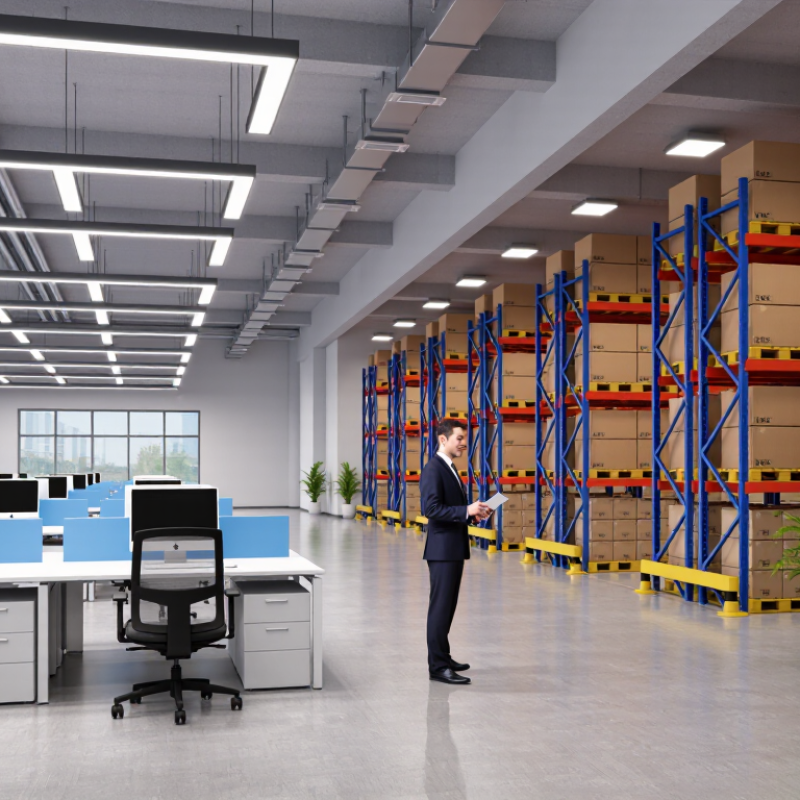
How Does Commercial LED Lighting Reduce Energy Costs?

What Commercial LED Lighting Is and How It Works

How Does Commercial LED Lighting Reduce Energy Costs?

Commercial LED lighting uses solid-state semiconductors to create light. Unlike older fluorescent lamps, LEDs do not heat a gas tube to produce illumination. An electronic driver converts incoming AC power into controlled DC power for the LED chips. The driver also helps maintain stable output when voltage changes slightly.

LEDs direct more light toward work areas. Reflectors and lenses reduce wasted light above ceilings or inside fixtures. A warehouse aisle, for example, can receive focused illumination instead of scattered brightness. This often allows a facility to use fewer watts while meeting workplace lighting requirements. LEDs also start instantly and support dimming, occupancy sensors, and daylight controls.

Controls matter greatly. A sensor can lower output when a meeting room is empty. Daylight harvesting can reduce output near windows during sunny hours. In practice, energy savings depend on operating schedules, fixture quality, maintenance, and control settings. The technology is not magic. Poorly designed layouts may create glare, dark corners, or unnecessary brightness. A lighting audit should measure existing wattage, daily runtime, lux levels, and maintenance history before replacement. One retrofit may achieve impressive savings, while another produces modest results because lights already operate infrequently. Heat management also deserves attention. Excessive heat can shorten LED life and reduce performance, especially in enclosed fixtures. Careful installation makes the energy model more trustworthy.

Why LED Fixtures Use Less Electricity Than Traditional Lighting

Commercial LED fixtures use less electricity because they convert more power into visible light. The U.S. Department of Energy reports that LED products can use at least 75% less energy than incandescent lighting. They also can last up to 25 times longer, reducing relamping work in warehouses, offices, and retail spaces. (U.S. DOE, “LED Basics”)

The difference becomes practical at the work surface. A fluorescent fixture may consume 64 watts, while an LED replacement can deliver similar light with about 35 watts. Across 100 fixtures operating ten hours daily, that change saves roughly 10,585 kilowatt-hours each year. The exact result depends on lighting levels, operating schedules, and local electricity prices. Small details matter.

Controls can reduce consumption further. Occupancy sensors switch lights off in empty meeting rooms. Daylight sensors dim fixtures near windows. The International Energy Agency identifies efficient lighting and controls as important tools for reducing electricity demand in buildings. Still, an LED retrofit is not automatically efficient. Poor optics may create glare, while excessive brightness wastes power. I have seen facilities install lower-wattage fixtures, then add more units to correct dark areas. That weakens the expected savings. A reliable assessment should measure existing illuminance, operating hours, fixture wattage, and control performance before replacement.

How Smart Controls Increase Commercial Lighting Efficiency

Commercial LED lighting lowers energy use, but smart controls often determine whether savings survive daily operation. The U.S. Department of Energy reports that LEDs use at least 75% less electricity than incandescent lighting. They can last up to 25 times longer. In commercial spaces, the bigger opportunity is control. Occupancy sensors switch off lights in empty meeting rooms. Scheduling prevents overnight operation. Daylight sensors dim fixtures beside windows when sunlight reaches desks. The result is practical: fewer watts, fewer replacements, and cooler ceiling zones.

Lawrence Berkeley National Laboratory’s 2017 review of networked lighting controls found typical savings of 24% to 38% in commercial buildings. These results depend on commissioning, room use, and occupant acceptance. A poorly aimed sensor can leave a corridor dark. A delayed sensor can frustrate staff. Controls are not magic. Their value comes from measured settings, clear override rules, and monthly checks of schedules and fault alerts. Metering also shows whether promised reductions appear on utility bills.

Tips: Start with zones, not the whole building. Use vacancy mode in private offices. Set gradual dimming near windows. Protect critical paths with minimum light levels. Review complaints before raising every setting. That last step matters.

How Does Commercial LED Lighting Reduce Energy Costs?

Annual lighting electricity use for a representative 100-fixture commercial space operating 2,600 hours per year. LED lighting uses 40% less energy than 40 W fluorescent fixtures, while smart controls provide an additional 20% reduction through occupancy and daylight-based dimming.

Estimated annual electricity cost at $0.15 per kWh: Fluorescent: $1,560; LED: $936; LED with smart controls: $749.

Which Factors Determine Energy Savings in Commercial LED Systems

Commercial LED energy savings depend on the whole system, not the lamp alone. The U.S. Department of Energy reports that LED products can use at least 75% less energy than incandescent lighting. Commercial retrofits often start with a smaller gap, especially when replacing efficient fluorescent equipment. The baseline matters.

Consider 100 fixtures. Replacing 150-watt units with 80-watt LEDs cuts connected load by 7 kilowatts. At 12 operating hours daily and 300 days annually, that equals 25,200 fewer kilowatt-hours. At $0.15 per kilowatt-hour, annual lighting savings reach about $3,780 before controls, demand charges, and maintenance changes. Actual results may differ.

Operating hours strongly influence payback. Occupancy sensors, daylight dimming, scheduling, and zoning can reduce unnecessary runtime. The U.S. Department of Energy identifies lighting controls as a major source of additional savings in commercial buildings. The International Energy Agency’s Energy Efficiency 2023 report also emphasizes efficient lighting and controls as practical electricity-saving measures.

Tariffs, fixture quality, ceiling height, light levels, and maintenance schedules also shape results. LEDs may reduce cooling demand because they release less heat, but the benefit depends on climate and HVAC operation. Field audits sometimes uncover over-lighted spaces, poor sensor placement, or controls disabled by occupants. That is an uncomfortable detail. A theoretical 70% reduction can become much smaller without commissioning, measurement, and post-installation adjustment.

How Does Commercial LED Lighting Reduce Energy Costs? — Which Factors Determine Energy Savings in Commercial LED Systems?
Energy-Saving Factor Typical Conventional Condition Commercial LED Condition Illustrative Energy Effect Why It Matters to Operating Costs
Lighting efficacy Older fluorescent systems commonly provide approximately 60–100 lumens per watt, including lamp and ballast effects. Many commercial LED luminaires provide approximately 100–180 lumens per watt, depending on the product and operating conditions. Higher efficacy can reduce lighting wattage by roughly 20–50% for a similar light output. Less electricity is required to produce the same useful illumination, directly reducing lighting-related kWh consumption.
Fixture wattage and light distribution Conventional lamps may deliver light inefficiently, requiring higher wattage or additional fixtures to reach target illuminance. LED optics can direct light more precisely onto work areas, reducing wasted uplight and spill light. A well-designed LED layout may lower connected lighting load beyond the lamp-efficiency improvement alone. Lower connected load reduces both energy use and, in some utility tariffs, demand charges.
Operating hours Lighting may operate 3,000–5,000 hours per year in offices, retail spaces, warehouses, and other commercial buildings. LED systems provide savings during every operating hour and maintain efficient performance over frequent switching cycles. Annual savings increase in proportion to operating hours. Facilities with long schedules, multiple shifts, or 24-hour operation generally achieve faster payback.
Occupancy and vacancy control Traditional lighting is often left on in unoccupied rooms, aisles, restrooms, or storage areas. LED luminaires can be paired with occupancy sensors, vacancy sensors, or networked controls. Control-based reductions commonly range from approximately 10–40%, depending on occupancy patterns and settings. Turning lights down or off when spaces are unused avoids unnecessary runtime without reducing occupied-space illumination.
Daylight harvesting Fixed-output lighting may operate at full power even when windows or skylights provide sufficient daylight. Dimming controls can reduce LED output when measured daylight meets part of the required illuminance. Daylight-responsive areas may achieve additional lighting-energy reductions, often around 10–30% where daylight is available. Electric lighting is reduced during daylight hours while the control system maintains the programmed light level.
Dimming capability Many older systems have limited dimming capability or require separate control equipment. Compatible LED drivers can support scheduled dimming, task tuning, and centralized lighting controls. Reducing light output during low-use periods lowers wattage and can extend useful operating life. Lower output during cleaning, after-hours security periods, or partial occupancy reduces energy use.
Standby and control-system power Conventional fixtures may have little or no networked-control standby load, but they also lack automated energy management. Connected LED systems consume a small amount of power for sensors, drivers, and communication when operating or on standby. The control-system load must be included in a whole-system energy calculation. Efficient controls should produce greater operating savings than the additional standby energy they consume.
Lamp and ballast replacement Fluorescent, compact fluorescent, and high-intensity-discharge lamps require periodic replacement; failed ballasts may also require service. LED luminaires generally have longer rated lives and do not use replaceable fluorescent lamps or magnetic ballasts. Longer service intervals reduce maintenance labor, lift access, replacement materials, and disposal activity. Maintenance savings are separate from electricity savings but can materially improve total project economics.
Power demand and peak periods Higher lighting wattage contributes to a building's electrical demand, especially when many fixtures operate simultaneously. Lower connected lighting load reduces the lighting component of peak demand. Demand savings depend on the utility tariff, peak-hour timing, and whether lighting operates during the measured demand interval. Facilities billed for both energy and demand may reduce total utility costs more than an energy-only calculation indicates.
Electricity rate Energy savings are valued using the facility's applicable electricity price, which may include time-of-use rates, demand charges, taxes, or fees. The same LED retrofit produces different financial results under different tariffs. Annual cost savings = avoided kWh × energy rate + avoided kW × demand rate, where applicable. Electricity pricing is a financial factor rather than a lighting-efficiency factor, but it strongly affects payback and return on investment.
Thermal interaction with HVAC Less-efficient lamps convert a larger share of electrical input into heat inside the conditioned space. LEDs generally use less electrical power for the same light output and can reduce internal heat gains. Cooling-energy savings may occur in air-conditioned buildings, while heating-energy effects vary by climate and season. HVAC impacts should be modeled separately because the result depends on climate, equipment efficiency, operating schedule, and building use.
Light level and task tuning Older installations may be over-lighted because of outdated layouts, lumen depreciation, or broad fixed-output operation. LED output can be selected and tuned to meet the actual illuminance requirement for each space. Avoiding over-lighting can reduce installed wattage and improve visual comfort. Energy savings should be based on required lighting levels and applicable standards, not on simply reducing light below safe or suitable levels.
Illustrative ranges are general commercial-building benchmarks, not guaranteed results. Actual savings depend on existing fixture wattage, LED efficacy, lighting layout, operating schedule, control settings, maintenance practices, utility rates, demand charges, climate, and required illuminance. A reliable project estimate should compare measured or verified baseline conditions with the proposed LED system.

How Businesses Measure and Maintain LED Energy Cost Reductions

Commercial LED lighting can lower energy costs, but businesses must measure the reduction carefully. Start with a baseline from twelve months of electricity bills. Record lighting wattage, operating hours, occupancy, and seasonal changes. A warehouse using lights ten hours daily needs a different comparison than a shop open late.

After installation, review kilowatt-hours monthly. Separate lighting savings from changes in heating, cooling, production, or staffing. Smart meters can show evening peaks and unusual daytime use. Compare similar operating periods, not only the total bill. A cooler month may increase heating demand and hide genuine lighting savings. Savings are not always clean.

Maintenance protects the original result. Check occupancy sensors near busy doors and loading areas. Dusty fixtures can reduce useful light, even when their energy use stays low. Replace damaged controls quickly. Keep a simple log with inspection dates, measured lux levels, lamp failures, and operating schedules. Real facilities experience matters here; a schedule that looks efficient may frustrate workers and lead to manual overrides.

Tips:

Assign one person to review monthly data. Photograph meter readings. Test sensors after furniture moves. Ask staff about dark zones or excessive brightness. Recheck savings after renovations. Small errors matter. A forgotten override can keep an entire aisle illuminated overnight.

FAQS

How does commercial LED lighting reduce energy use?

LEDs create light through semiconductor chips and controlled electronic drivers. Lenses direct light toward desks, floors, and warehouse aisles. Less light is wasted above ceilings or inside fixtures. Actual savings depend on layout, runtime, and maintenance.

How much electricity can commercial LED lighting save?

LED products may use at least 75% less electricity than incandescent lighting. Replacing efficient fluorescent fixtures usually creates smaller savings. The starting system matters. A lighting audit should confirm the real baseline.

Can you show a practical energy-saving example?

Replacing 100 fixtures rated at 150 watts with 80-watt fixtures cuts connected load by 7 kilowatts. At 12 hours daily and 300 days yearly, savings reach 25,200 kilowatt-hours. At $0.15 per kilowatt-hour, annual savings may approach $3,780. This is only an estimate.

How do smart controls improve commercial lighting efficiency?

Occupancy sensors reduce output when rooms or offices are empty. Schedules can prevent lights from operating overnight. Daylight sensors dim fixtures near sunny windows. Controls often determine whether savings continue after installation.

What problems can poorly configured lighting controls cause?

A badly aimed sensor may leave a corridor dark. A delayed sensor can frustrate employees. Excessive overrides may keep lights fully illuminated. Controls are not magic.

Which building conditions affect LED energy savings?

Operating hours strongly influence payback. Ceiling height, light levels, tariffs, fixture quality, and maintenance also matter. A rarely used room may produce modest savings. The expected result can be overstated.

Can LED lighting reduce cooling costs?

LEDs generally release less heat than older lighting technologies. Lower heat may reduce cooling demand in some buildings. The benefit depends on climate and HVAC operation. It should not be treated as guaranteed.

What should a facility measure before and after an LED retrofit?

Measure fixture wattage, daily runtime, light levels, and maintenance history. After installation, review utility bills, sensor settings, complaints, and fault alerts. Check for glare, dark corners, and unnecessary brightness. The model can be wrong.

Conclusion

Commercial LED lighting is a modern system that uses light-emitting diodes to convert electricity into light more efficiently than traditional bulbs. How does commercial led lighting reduce energy costs? It uses less power to produce the same brightness, generates less wasted heat, and typically lasts much longer, reducing both electricity consumption and replacement expenses. LED fixtures can also provide more focused, consistent illumination, helping businesses avoid over-lighting spaces.

Smart controls can increase these savings by adjusting lighting according to occupancy, daylight levels, schedules, and activity needs. Actual energy reductions depend on factors such as operating hours, fixture efficiency, building size, lighting design, local electricity rates, and the quality of installation. Businesses can measure results by comparing energy bills, tracking usage data, and reviewing maintenance records before and after conversion. Regular cleaning, inspections, timely repairs, and periodic control-system adjustments help preserve performance and ensure that commercial LED systems continue delivering lower energy costs over time.

Henry

Henry

Henry is a dedicated marketing professional with a profound expertise in the company's offerings. With years of experience in the industry, he possesses an impressive understanding of the market dynamics and consumer behaviors that drive success. Henry is committed to sharing his insights through......