Choosing commercial LED lighting in 2026 requires more than comparing wattage and purchase price. Each industry has different operating hours, safety demands, ceiling heights, and visual tasks. A supermarket needs bright, uniform aisles. A warehouse needs high-bay fixtures with accurate occupancy sensing. A clinic requires comfortable light that supports careful examinations without creating glare.
So, what industries benefit most from commercial led lighting? Retail, hospitality, healthcare, education, manufacturing, offices, warehouses, and parking facilities often gain measurable value. Practical lighting audits show where savings actually occur. They also reveal problems that product brochures may hide. A fixture can claim high efficiency yet perform poorly in a dusty, humid, or frequently occupied space. No fixture is perfect.
This guide explains how to match LED specifications with real working conditions. It considers lumen output, color temperature, color rendering, beam angle, controls, maintenance access, and expected service life. Manufacturer data matters, but installation quality matters too. Poor placement can leave dark aisles, harsh shadows, or distracting reflections on screens. Energy monitoring can help verify the results after installation. Simple checks, such as measuring light levels during peak activity, add useful evidence.
The best choice may not be the newest product. It may be the one that remains reliable after years of cleaning, switching, vibration, and temperature changes. Some recommendations will require careful judgment. Industry labels alone cannot predict every building’s needs. This is where professional assessment becomes valuable, even when the answer seems obvious.
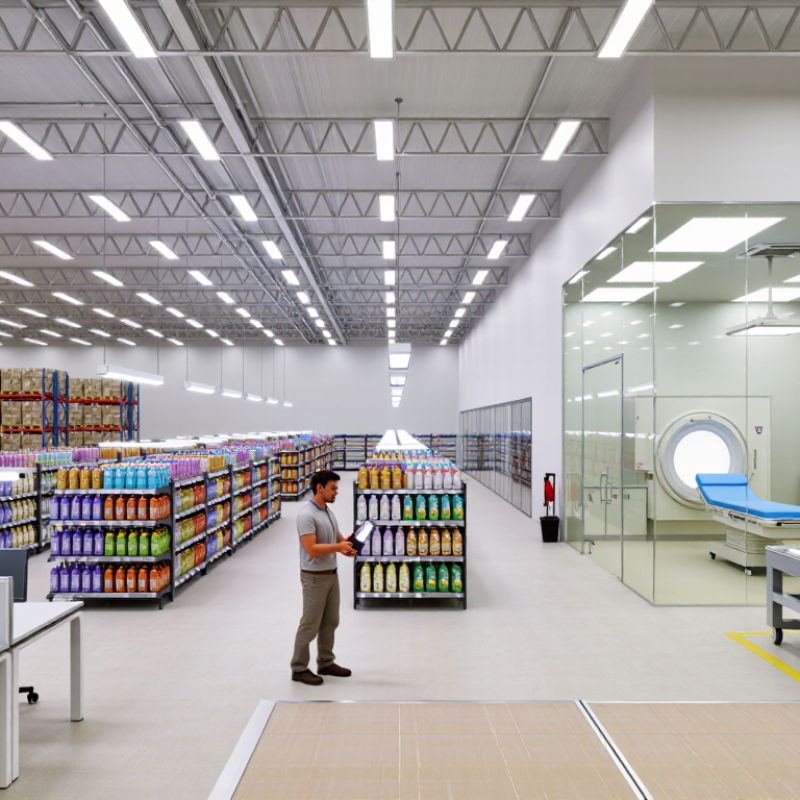
How to Choose Commercial LED Lighting by Industry in 2026?
Define Industry-Specific Lighting Needs and Performance Goals
The specification should begin with work, not wattage. A warehouse needs uniform vertical illumination, impact resistance, and rapid occupancy response. A clinic needs low flicker, stable color, and comfortable facial visibility. Retail spaces may prioritize color rendering, beam control, and flexible scenes. These goals are not interchangeable. The IEA’s Energy Efficiency 2023 report estimates that lighting uses about 15% of global electricity. That figure makes efficiency important, but it does not define useful light.
Set performance goals by task and risk. Offices should document maintained illuminance, glare limits, daylight dimming, and screen comfort. Warehouses should measure aisle uniformity, mounting height, temperature, and control response. Food facilities require cleanable housings and careful shadow control. Healthcare projects need emergency-lighting coordination and documented color stability. The U.S. Department of Energy’s Solid-State Lighting R&D Opportunities report describes laboratory LED efficacy above 200 lumens per watt. Installed performance depends on optics, drivers, heat, and dirt. A high number on a datasheet can still disappoint.
Ask for LM-79 performance data, LM-80 lumen-maintenance evidence, and TM-21 projections. Verify flicker, glare, color quality, warranty terms, and replacement access. Use site measurements before final selection. A 4000 K setting may suit a loading dock but feel harsh in a hotel corridor. Controls also need commissioning. Otherwise, sensors become expensive decoration. I have seen projects chase maximum efficacy and overlook nighttime comfort. That trade-off deserves review. The best specification may remain partly uncertain when schedules, ceiling heights, and user behavior change.
Commercial LED lighting decisions should start with the work, not the fixture catalog. Warehouses need high-bay fixtures with controlled glare and wide aisle coverage. Retail spaces often need track or linear fixtures with strong color rendering. Offices benefit from low-glare panels and comfortable vertical illumination. The U.S. Department of Energy’s 2023 Solid-State Lighting report notes that advanced LED products can exceed 150 lumens per watt, but real performance depends on temperature, optics, and driver quality. A bright fixture can still waste light on empty walls.
Compare LED technologies by useful light, lifetime, and maintenance access. Standard LED packages suit general lighting, while tunable-white systems support changing schedules and visual comfort. High-CRI products improve color accuracy, although they may reduce efficacy. The DesignLights Consortium’s technical requirements emphasize efficacy, quality, and tested performance rather than marketing claims. Controls create another major difference. Occupancy sensors, daylight dimming, and scheduling can reduce operating energy, but poor commissioning causes false shutoffs and user complaints. ASHRAE Standard 90.1 includes control provisions for commercial spaces, while the U.S. Department of Energy reports that integrated controls can produce substantial additional savings beyond efficient lamps. My field experience suggests simple controls often outperform complicated ones. Not always. A sensor placed behind storage racks may miss movement, and an app cannot repair bad zoning. Review photometric files, warranty terms, driver temperature ratings, and measured control performance before approval.
The chart shows representative maintained illuminance planning values commonly used for commercial and industrial spaces. Actual requirements vary by task, room geometry, surface reflectance, local regulations, and the applicable lighting standard.
Use high-efficacy LED panels or linear fixtures with low-glare optics. Occupancy and daylight controls can reduce unnecessary operating hours.
Combine general lighting with adjustable track or spotlight fixtures. High color rendering is important for merchandise presentation and visual accuracy.
High-bay or aisle optics improve vertical illumination and reduce wasted light. Motion sensors, scheduling, and zoning are especially effective.
Choose sealed, impact-resistant fixtures where dust, moisture, vibration, or temperature variation is present. Use task lighting for detailed work.
Prioritize visual comfort, glare control, flicker performance, and high color rendering. Tunable white systems may support different care activities.
Choosing commercial LED lighting in 2026 starts with the work, not the fixture catalog. A warehouse needs clear vertical visibility, durable housings, and controlled glare. A food facility may require sealed luminaires and cleanable surfaces. Offices need low flicker, comfortable color rendering, and balanced brightness. Match each selection to local electrical, fire, accessibility, and emergency-lighting requirements. Confirm classifications with the authority having jurisdiction and a qualified electrical professional. Codes differ by location. Assumptions create risk.
Safety details should survive a real inspection. Check ingress protection for washdown areas, impact resistance near loading bays, and operating temperatures above ovens or cold rooms. Verify mounting, circuit loading, grounding, emergency duration, and control-system compatibility. Keep test reports, photometric files, warranties, and maintenance instructions in the project record. This evidence supports reliable decisions and helps facility teams troubleshoot later. Do not accept a generic “compliant” claim without applicable standards and documentation.
Sustainability means more than low wattage. Compare delivered lumens, useful life, replacement access, power controls, and material recovery options. Occupancy sensors can reduce empty-room energy use, but poor placement causes irritating shutoffs. Dimming must be commissioned. It is often overlooked. Specify suitable color temperature and CRI for the task, while avoiding excessive blue-rich light in occupied spaces. A modest redesign may cost more upfront, yet reduce energy, relamping labor, and waste. Still, every projection deserves checking against actual operating hours and utility conditions.
A practical comparison of typical illuminance, visual comfort, safety, controls, and sustainability requirements. Final specifications must be verified against local legislation, building codes, and project-specific risk assessments.
| Industry / Area | Typical Maintained Illuminance | Recommended CRI and CCT | Glare and Uniformity Guidance | Safety and Environmental Requirements | Controls and Energy Strategy | Relevant Standards and Codes |
|---|---|---|---|---|---|---|
| Office and Administrative Workspaces | 300–500 lux on the working plane; approximately 500 lux for detailed desk-based tasks. | CRI ≥80; 3500–4000 K for general work areas. Use higher color quality where color evaluation is important. | Target UGR ≤19 for computer-based work; maintain even distribution and control reflected glare on screens. | Provide emergency lighting and illuminated escape routes where required. Consider flicker performance and accessibility needs. | Occupancy and daylight sensors, task tuning, zoning, dimming, and scheduling. Select efficient luminaires with replaceable components where practical. | EN 12464-1; ISO/CIE 8995-1; local electrical, accessibility, emergency-lighting, and energy codes. |
| Retail and Showrooms | 300–750 lux for sales areas; 750–1000 lux may be used for merchandise inspection or high-detail displays. | CRI ≥90 for apparel, food, cosmetics, and premium merchandise; typically 3000–4000 K depending on the desired atmosphere. | Target UGR ≤22 in general sales areas; use precise beam control to reduce customer discomfort and improve product emphasis. | Use low-surface-temperature equipment where required, protected wiring, and emergency egress lighting. Food areas may require additional hygiene controls. | Scene control, time scheduling, occupancy sensing in back-of-house areas, and daylight dimming near storefront glazing. | EN 12464-1; local fire, electrical, emergency-lighting, accessibility, and retail safety requirements. |
| Warehouses and Distribution Centers | 100–200 lux for storage aisles; 300 lux or more for packing, checking, and dispatch tasks. | CRI ≥80; 4000–5000 K is commonly selected for visual clarity and alertness. | Target UGR ≤25 where applicable; provide vertical illumination on rack faces and avoid glare for forklift operators. | Select suitable IP protection for dust, moisture, and washdown conditions; protect fixtures from impact and maintain clear emergency routes. | Aisle-by-aisle occupancy control, high-bay dimming, daylight harvesting, and network monitoring. Use controls that fail safely. | EN 12464-1; ISO/CIE 8995-1; local machinery, fire, electrical, workplace-safety, and emergency-lighting codes. |
| Manufacturing and Assembly | 300–500 lux for ordinary assembly; 750–1000 lux for precision inspection and fine assembly. | CRI ≥80 for general production; CRI ≥90 where color matching, surface inspection, or quality control is critical. Usually 4000–5000 K. | Target UGR ≤22–25 depending on the task; specify low-flicker products near rotating machinery and cameras. | Assess dust, oil, heat, vibration, impact, and hazardous-area classification. Use appropriate IP, IK, temperature, and ingress protection ratings. | Zone controls, occupancy sensing, maintenance alerts, and task lighting at inspection stations. Avoid automatic dimming where it could affect machine safety. | EN 12464-1; IEC 60529 for IP ratings; IEC 62262 for IK ratings; applicable hazardous-location, machinery, electrical, and workplace-safety codes. |
| Healthcare and Clinical Facilities | 100–300 lux for patient rooms and circulation; 500–1000 lux for examination, treatment, and clinical work, depending on the task. | CRI ≥80 for general areas; CRI ≥90 is preferred for examination and diagnostic tasks. Commonly 3000–4000 K. | Use low-glare, low-flicker luminaires; control direct and reflected glare for patients, clinicians, and medical displays. | Consider cleanable surfaces, infection-control procedures, electrical safety, medical locations, emergency power, and night-lighting requirements. | Separate patient, staff, examination, and night scenes. Use dimming and presence controls without compromising observation or clinical safety. | EN 12464-1; IEC 60601-1 where applicable; local healthcare, electrical, fire, emergency-power, and infection-control requirements. |
| Schools and Educational Buildings | 300–500 lux in classrooms; approximately 500 lux for technical drawing, laboratories, and detailed activities. | CRI ≥80; 3500–4000 K is widely suitable for classrooms, with higher color quality for art and science spaces. | Target UGR ≤19 in classrooms and computer rooms; maintain uniform light on desks and whiteboards. | Specify robust, low-flicker, low-glare products; address emergency routes, child safety, impact resistance, and accessible controls. | Daylight-linked dimming, occupancy sensing, teacher override, scheduled setback, and classroom-by-classroom zoning. | EN 12464-1; ISO/CIE 8995-1; local education, fire, accessibility, electrical, and emergency-lighting codes. |
| Hotels, Restaurants, and Hospitality | 100–300 lux for dining and guest areas; 300–500 lux for reception, service counters, kitchens, and back-of-house tasks. | CRI ≥80; CRI ≥90 is recommended for food presentation and interior finishes. Typically 2700–3500 K for guest areas and 3500–4000 K for service areas. | Prioritize visual comfort and concealed sources; use carefully aimed accent lighting to avoid glare for seated guests. | Select sealed, cleanable fixtures for kitchens and wet areas; consider heat, grease, moisture, fire-rating, and emergency-egress requirements. | Preset scenes, occupancy control in corridors and back-of-house zones, time schedules, and low-level nighttime operation. | EN 12464-1; IEC 60529 where applicable; local food-hygiene, fire, electrical, accessibility, and emergency-lighting codes. |
| Parking Garages and Exterior Commercial Areas | Approximately 50–100 lux in pedestrian and vehicle zones; transition areas may require higher levels based on traffic and daylight conditions. | CRI ≥70 for general circulation; 3000–5000 K depending on security, visibility, environmental, and community considerations. | Use uniform horizontal and vertical illumination; limit disability glare and spill light toward neighboring properties and roads. | Use weather-resistant, impact-resistant luminaires with suitable IP and IK ratings; address emergency lighting, CCTV visibility, and safe pedestrian routes. | Motion-based dimming with a safe minimum level, daylight sensing, photocells, astronomical scheduling, and remote fault monitoring. | EN 12464-1; CIE 115 for road and outdoor lighting principles; IEC 60529; local parking, road, fire, electrical, and light-pollution requirements. |
2026 selection checklist: Verify maintained illuminance rather than initial output, confirm lumen maintenance and rated life, request flicker and glare data, select the correct IP/IK or hazardous-area protection, integrate occupancy and daylight controls, and document energy performance and end-of-life recovery requirements.
Important: The illuminance ranges above are typical planning values, not universal legal minimums. Local regulations, occupational risk assessments, emergency-lighting rules, environmental conditions, and the exact visual task take precedence.
Choosing commercial LED lighting by industry in 2026 starts with measured energy use, not fixture wattage alone. Record each area’s operating hours, light levels, ceiling height, and electricity tariff. A warehouse may run 4,000 hours yearly, while a retail store may need brighter lighting for longer trading periods. Offices often gain more from occupancy sensors than from maximum brightness.
Consider a simple warehouse example. Replacing 100 older 150-watt fixtures with 60-watt LED fixtures reduces connected load by 9 kilowatts. At 4,000 operating hours, the annual saving reaches about 36,000 kilowatt-hours. With electricity priced at $0.14 per kilowatt-hour, that equals roughly $5,040 yearly. Check demand charges too. They can change the result.
Installation costs include fixtures, electricians, lifts, wiring repairs, controls, disposal, and possible after-hours labor. A project costing $18,000 may show a simple payback near 3.6 years before maintenance savings. However, this estimate is too neat. Actual savings may fall when aisles stay empty or controls are poorly commissioned. In food facilities, sealed fittings and cleaning requirements can raise costs. In offices, glare control and color quality matter more than the lowest purchase price. Ask an electrician to verify circuit capacity and emergency-lighting requirements. Compare at least three proposals using total cost over ten years, not just the invoice. Include lamp replacements, cleaning, rebates, tariff changes, and sensor failures. Small assumptions deserve scrutiny.
Commercial LED lighting should match the work, not merely the ceiling height. Warehouses need uniform aisles, low-glare optics, occupancy controls, and durable housings. Offices require comfortable brightness, controlled reflections, and adjustable color temperature. Retail spaces may need stronger accent lighting and accurate color rendering. Healthcare areas demand visual clarity, cleanable surfaces, and dependable emergency operation.
Start with a site survey. Measure illuminance at work surfaces, note mounting heights, record operating hours, and inspect existing circuits. The U.S. Department of Energy reports that LED products can use at least 75% less energy and last up to 25 times longer than incandescent lighting. However, savings depend on controls, maintenance, and actual usage.
A poor layout can waste energy while creating dark corners. That happens.
Choose products against recognized performance requirements, including efficacy, glare control, color rendering, flicker, thermal management, and rated life. For offices, verify compliance with applicable energy standards such as ASHRAE 90.1. For industrial sites, review ingress protection and ambient-temperature ratings. The DesignLights Consortium’s technical requirements also provide a useful benchmark for commercial product qualification.
Do not trust catalog figures alone. Request test reports, warranty terms, photometric files, and control compatibility. Installers should commission sensors, dimming zones, and emergency circuits after installation. Evaluate results after several weeks using energy bills, occupant feedback, and measured light levels. Initial assumptions are often wrong.
Start with the work area, not a fixture catalog. Warehouses need wide aisle coverage and controlled glare. Offices need comfortable light and low reflections. Retail areas often need accurate color rendering. A bright fixture can still waste light on empty walls.
Compare useful light, lifetime, maintenance access, glare, flicker, and thermal performance. High-color-accuracy products may use more energy. Check tested performance, not only catalog claims. Request photometric files and warranty terms. Details matter.
Yes. Occupancy sensors, daylight dimming, and schedules can reduce operating hours. Simple controls often perform better than complicated systems. Poor commissioning causes false shutoffs and complaints. A sensor behind storage racks may miss movement. An app cannot fix bad zoning.
Compare connected load, operating hours, and electricity rates. Replacing 100 fixtures rated at 150 watts with 60-watt fixtures saves 9 kilowatts. At 4,000 hours yearly, that equals about 36,000 kilowatt-hours. At $0.14 per kilowatt-hour, savings reach roughly $5,040 yearly. Demand charges may change this result.
Include fixtures, electricians, lifts, wiring repairs, controls, disposal, and after-hours labor. Add cleaning, future replacements, rebates, tariff changes, and sensor failures. A project costing $18,000 may show a 3.6-year simple payback. That estimate is too neat. Real savings can be lower.
Measure light levels at work surfaces and record mounting heights. Note operating hours, ceiling conditions, circuit capacity, and emergency-lighting needs. Inspect dark corners and existing wiring. Ask an electrician to verify the circuits. Assumptions are often wrong.
Warehouses need uniform aisles, durable housings, and low-glare optics. Offices need comfortable brightness and controlled reflections. Retail spaces may need accent lighting and accurate colors. Healthcare areas require cleanable surfaces and dependable emergency operation. One design rarely fits every room.
Commission sensors, dimming zones, and emergency circuits before approval. After several weeks, review energy bills, measured light levels, and occupant feedback. Check whether dark areas, glare, or false shutoffs remain. Early results may disappoint. Adjust the system instead of assuming the design succeeded.
Choosing commercial LED lighting in 2026 requires more than selecting the brightest fixtures. Businesses should first define industry-specific needs, including task visibility, occupancy patterns, color accuracy, glare control, and maintenance expectations. Asking what industries benefit most from commercial led lighting can help guide priorities across offices, retail spaces, warehouses, healthcare facilities, hospitality venues, and manufacturing environments. Each application may require different fixture types, beam angles, color temperatures, dimming options, sensors, and centralized control systems.
A successful lighting plan must also align with applicable safety standards, energy-efficiency goals, sustainability policies, and building requirements. Comparing energy use, installation complexity, maintenance costs, and expected service life can reveal the system’s total long-term value rather than focusing only on the initial price. After selecting suitable equipment, professional installation, commissioning, and performance evaluation are essential. Measuring illumination, energy consumption, occupant comfort, and control effectiveness allows businesses to confirm that the LED system delivers reliable performance, lower operating costs, and a better environment for employees, customers, and visitors.

Bluu Light